

Author – Joanna De Klerk
There can be so much more to owning a Bengal cat than keeping one as a pet. Some people make their passion their career, and delve into the world of showing and breeding Bengals. This should not be taken light-heartedly, as you will be responsible for the livelihoods of potentially multiple Bengals, which can be a big responsibility. But if you are interested in showing or breeding your Bengal, this guide will guide you through the basics to get you on your way.
Showing

Showing your cat can be an exciting experience. Showing and breeding often go hand in hand to help improve the breed standard. However, you do not have to breed your cats if you show them, nor do you have to show your cats if you breed them.
The GCCF has now established a breed standard for the Bengal, which means more UK Bengals are appearing on the show circuit. This will certainly bring the breed more attention and praise as people begin to realise the beauty of the Bengal.
Choosing a show cat
You should take some time and consideration when you choose a show cat. Starting with a kitten is the best option. This way, you have a blank canvas to train to accept the show environment. Older tom cats will be stressed by the environment of a show when he is surrounded by queens, and likewise, if your queen is in oestrous, she will also find the showing environment distracting and stressful if she is not used to it.
Therefore, it is vital that you choose a cat for showing which has an excellent temperament. This will be down to a mixture of nature and nurture. Nurture is based on how you prepare your cat for a show, however, nature you will not have an influence on. As a result, it is important to choose a kitten wisely. When you choose a kitten, look at the temperament of the parents, as this will be a good indication of his temperament to come.
If you are not able to view the father, the breeder should be able to give you contact details of his owner to ask questions. The kittens should be inquisitive and playful. The best to choose is neither the most boisterous nor the quietest. If you are unsure, the breeder will always be happy to help you, as it is in their best interests to ensure their kittens are well matched with their future owners.
Keeping your cat calm
The most stressful part of a show for your cat is to be placed in a basket. Most cats only go in a basket to travel to the vets or a cattery, and therefore it can be associated with a stressful experience. With a little bit of effort, you can teach your cat to love being in their basket, but this must be done from a young age.
Start by placing a large basket on the floor in the house, with their favourite toy, blanket or some treats in it. Allow him to explore in his own time, with the hope that he realises that the basket is a safe place to be. You can leave the basket down in the house for a few hours every day, then take it away again, and then he will not associate the basket appearing with going anywhere.
Once he is happy with his basket, you should take him for a short drive. Start with just five minutes around the neighbourhood, then when you arrive home, give him a bowl of something tasty to eat as a reward, such as tuna. Cats can suffer from travel sickness, like humans do, and therefore do not give your cat a bowlful of food prior to travelling. Once your cat starts to associate travelling with feeling sick, he will have a negative feeling towards the basket, and so preventing this association should be considered from the start.
You should also get your Bengal used to people touching him and looking at him. At the show, there will be a large number of people walking around and looking into his crate. For Bengals, this is generally less stressful in comparison to other breeds, as they are extremely sociable and nosy, but for some it can be overwhelming. Additionally, judges are likely to touch him as they inspect his conformation. Therefore, from the age of a kitten, make a habit to regularly touch his ears, tail and paws, as these are the areas that cats are most irritable about.
Preparing for a show
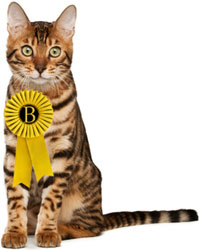
There are a few things that you should routinely do before a show, but generally it doesn’t take hours of preparation. A few days before the show, check for fleas. You should be applying routine flea treatments anyway, and so the chances of finding one are remote, but if your Bengal has even one flea, he may be disqualified. Depending on the flea treatment you use, and the dosing intervals, you may want to give him a dose, just to make sure. However, ensure that you do not overdose your cat by giving him a flea treatment too close to the last one, so consult your veterinarian to ensure that it is safe to do so.
The day before the show, clean his ears with a feline ear cleaner. This can be purchased online, at your local pet store or at your vets. Do this by inserting the nozzle down the ear canal and giving a squeeze. Next, massage the ear canal beneath the base of the ear for 20-30 seconds, then stop and stand back. You cat is likely to shake his head, but this will bring out all the wax so it should be encouraged. Once he’s done that, wipe away what has come out with a soft piece of cotton wool, and repeat with the other ear.
You will also want to clip your Bengal’s claws, to ensure they are not too long for the judge. Cats naturally retract their claws, and so you will need to press at the base of the nail to extend them. You can either use a cat nail clipper, which you can buy from the pet store, or a human toenail clipper, to clip the nails. As you do it, make sure you are careful not to catch the fleshy part in the middle, called the quick. Most cat nails are thin enough to easily visualise this though. If you are unlucky, and you do catch the quick, place pressure on the area for several minutes with a wad of cotton wool.
Finally, a few days before the show, and again the day before the show, give your Bengal a thorough brush to remove any loose hair which may distract from his striking coat.
Ensure you get a good night’s rest before the show and try to enjoy it. Whilst showing Bengals is a professional sport, it shouldn’t be taken too seriously, as this will distract from the enjoyment of the day, and place extra stress on your Bengal.
Breeding
Deciding to breed your Bengal is a big decision to make. Not only will you need to care for your pregnant cat, but also care for the health and welfare of her kittens, during pregnancy, birth, the first eight weeks and in finding them suitable homes. There are many kittens and cats in the world with no homes, and so it is not responsible to allow your cat to have one litter because ‘it would be nice to have kittens in the house’. But if you are keen to delve into the professional world of breeding, then this can be an exciting opportunity to contribute to the Bengal genetic pool and improve the breed.
Choosing a breeding cat
Much like choosing a show cat, you should look into the genetics of the parents before you choose a kitten to breed. Additionally, not all breeders allow their kittens to go to breeding homes, and therefore enquiring prior to visiting the kittens is important.
When you choose a kitten to become a breeding cat, you should consider the conformation of the parents, temperament for handling, and ensure the parents do not have any breed predisposed diseases. Check the kitten for congenital issues, such as umbilical hernias, cleft palates, two descended testicles (if you’re purchasing a male – although sometimes these won’t have descended yet by this age, and that is normal), and heart murmurs.
During the first year of life, you should ensure your cat becomes easy to handle and is comfortable with living indoors, as these traits will make your life easier when she is pregnant and has kittens. You should allow her to mate after a few seasons, but not after five years of age.
The reproductive cycle
The reproductive cycle of the queen is fairly unusual compared to other animals. A queen will come into season, also known as oestrous or heat, many times in a year, and each time it can last 2-3 weeks. If she does not mate during this time period, she will then have a break for 1-2 of weeks, then come into season again. This happens several times, then she will have a period of time when she is not cycling. This time varies considerably between individual cats, geographical location, and time of year. The most common symptom of your Bengal coming into season, is her calling for a mate. If you thought normal Bengals were noisy, then you haven’t heard a Bengal in season!
A queen will ovulate when she has mated during her season. She will usually need to mate several times to stimulate the ovaries to release the eggs. This then will ensure the eggs are at the right part of the reproductive tract when the sperm reaches them for successful conception. She will go out of season a few days after she has been mated.
Looking after your pregnant queen
Pregnancy requires significantly more energy than a cat which isn’t pregnant, so it is important to feed her appropriately, which your veterinarian can advise you about. In general, she should eat 1.5x the amount of her normal food during pregnancy, and 2x the amount when she is lactating. She can also eat a kitten food, as this is higher in protein, calcium and phosphorus for the growth of muscles and bones of her kittens.
She will be pregnant for 63 days on average, but this may vary by two days either side. You can have her ultrasound scanned to confirm the pregnancy from three weeks of age, and later in pregnancy, a vet will be able to easily feel the kittens in her abdomen.
Most cats will easily give birth with little or no assistance from you, but keep an eye on her, as if she has been straining unproductively for a couple of hours, or there is a black or green discharge, then you should take her to your vets immediately, as she may need a caesarean.
Looking after newborn kittens
It is extremely exciting to have some new bundles of fur in your household. In the first few days, the mother is unlikely to leave them. Ensure the kittens are kept warm, out of drafts, and that each of them is successfully nursing. There may be one which is being bullied, or is the smallest, so you should monitor him carefully, as you may need to bottle raise him.
Some mothers can be extremely anxious when they have newborn kittens. When this happens, she may move them from one location to another frequently. This is dangerous for the kittens and can allow them to become cold. If she is doing this, provide a secluded dark area for her to keep her kittens in, or even consider caging her and the litter if this does not work.
The kittens will be born with their eyes closed. They will open between 7 and 14 days, and by two weeks, they should be standing tentatively. At three weeks, they will be climbing out the box, and at around four weeks, they can jump, run and play. Also, at around four weeks, they can manage food other than milk. You can offer them some kitten food to nibble on, to supplement their milk intake.
You should deworm them every two
As featured in…